Posts

After the financial crisis

Translated from Jean-Paul Betbèze, "Les leçons de la crise financière", Revue Etudes , Mars 2010. One can always think that lessons are going to be drawn from this crisis enlightning problems to be faced and new challenges to be considered. Indeed, nothing new will be possible without more saving in the United States, whithout more consuming in China; in other words United-States will have to accept a lower growth and China will have to think an economic growth outside of pure mercantilism. Nothing will ever be possible without a finer and faster control of the trade conditions of all goods and services; and at the first place, without the end of China's fixed rate with the US dollar. A tripolar world has been emerging, Asia, United-States, Europe: three currencies are needed. This world must be more and better monitored, with the commitment that: a) the rules will be stabilizing for everybody, and b) financial actors will be closely controlled by relevant and cooperat...
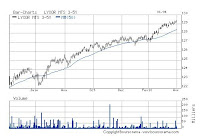

EuroMTS 3-5Y/+12bps/129.31 EUR

Image
LONDON (Reuters) - A key manufacturing survey rose to its highest level in over 15 years last month, and banks said they planned to step up corporate lending, in signs on Thursday that the recovery is gaining strength. However, the improvement is likely to take longer to filter through to households. The CIPS/Markit PMI purchasing managers' survey reported a small fall in factory employment, and a separate study showing less generous collective pay deals. The main news in support of recovery on Thursday was a rise in the headline manufacturing PMI index to 57.2 from 56.5, a bigger jump than economists had forecast and the index's highest level since October 1994, when the economy was also emerging from recession. With some caveats, economists treat the PMI and its output component as a proxy for growth in factory production, and Capital Economics estimated that it pointed to a quarterly rise in manufacturing output of just under 2 percent, almost...

Points of Inflection

Image
By Martha Minow (*) Although historians will surely devote much ink—or bytes—to the financial crisis, I believe that this time will be known as an inflection point in world history because of huge revolutions under way in the world—changes that make this an electrifying time to be in the legal profession. Consider the information technology revolution; the biomedical revolution, including genetic breakthroughs, biotechnology and nanotechnology; globalization affecting economic exchanges of legal and professional services; and the worldwide spread of biological and computer viruses, cultural trends and more. It’s also a time of great resource scarcity, global climate change, mass population growth and migrations of people. These shifts each day generate fundamental questions whose answers will alter the shape of the human experience. And I am certain that lawyers will play indispensable roles in tackling the issues raised by these developments and harnessing opportunities to secure orde...

Randomization of threats and promises

Image
An extract from T. C. Schelling Economics Division, The RAND Corporation, P-1716 June 5, 1959 [Preventing deduction and anticipation in a zero-sum game] In the theory of games of pure conflict ("zero-sum" games) randomized strategies play a central role. It may be no exaggeration to say that the potentialities of randomized behavior account for most of the interest in game theory during the past decade and half (*). The essence of randomization in a two-person zero-sum game is to preclude the adversary's gaining intelligence about one's own mode of play -- to prevent his deductive anticipation of how one may make up one's own mind, and to protect oneself from tell-tale regularities of behavior that an adversary might anticipate. In the game that mix conflict with common interest, however, randomization plays no such principal role, and the role it does play is rather different. [Giving fractional/sampled information to avoid total war situations in a general game...

Robust Optimization

Image
Decision under uncertainty with imperfect probabilistic description of reality The field of decision-making under uncertainty was pioneered in the 1950s by Dantzig [6] and Charnes and Cooper [5], who set the foundation for, respectively, stochastic programming and optimization under probabilistic constraints. While these classes of problems require very different models and solution techniques, they share the same assumption that the probability distributions of the random variables are known exactly, and despite Scarf's [10] early observation that we may have reason to suspect that the future demand will come from a distribution that differs from that governing past history in an unpredictable way," the majority of the research efforts in decision-making under uncertainty over the past decades have relied on the precise knowledge of the underlying probabilities . Even under this simplifying assumption, a number of computational issues arises, e.g., the need for multi-variate ...

Equity in a sweet spot - Gold against inflation

Image
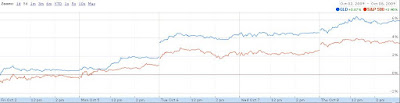
Equity are still in a sweet spot of low rates and government : +3,46% for SP500 and 6,29% for Pacific Ex-Japan (ETF EPP) since last Friday. Gold (+5,87% for GLD since last Friday) is picking up as it is seen as a hedge against a potential new inflation trend fueled by reflation [1]. [1] Reflation is the act of stimulating the economy by increasing the money supply or by reducing taxes . It is the opposite of disinflation . It can refer to an economic policy whereby a government uses fiscal or monetary stimulus in order to expand a country's output. This can possibly be achieved by methods that include reducing tax, changing the money supply, or even adjusting interest rates .

Financial Markets Shannon Capacity

Image
From Wikipedia, the free encyclopedia In information theory , the Shannon–Hartley theorem is an application of the noisy channel coding theorem to the archetypal case of a continuous-time analog communications channel subject to Gaussian noise . The theorem establishes Shannon's channel capacity for such a communication link, a bound on the maximum amount of error-free digital data (that is, information ) that can be transmitted with a specified bandwidth in the presence of the noise interference, under the assumption that the signal power is bounded and the Gaussian noise process is characterized by a known power or power spectral density. The law is named after Claude Shannon and Ralph Hartley . Claude Shannon 's development of information theory during World War II provided the next big step in understanding how much information could be reliably communicated through noisy channels. Building on Hartley's foundation, Shannon's noisy cha...