Posts

Japon: la sortie de 15 années de déflation?

Image
Danseuse de Rodin La Banque centrale du Japon (BoJ) a annoncé jeudi une accélération et une amplification des mesures d'assouplissement monétaire, afin d'atteindre en deux ans environ son objectif d'inflation de 2%, comme s'y est engagé le nouveau gouverneur, Haruhiko Kuroda. La Banque centrale du Japon (BoJ) confirme le chemin qu’elle a commencé à prendre ces derniers mois: celle d’une politique monétaire plus expansionniste, ayant pour objectif d’éloigner la croissance à 0%, de lutter contre la déflation et... de faire baisser le yen. Cette mesure est applaudie par nombre d'économistes notamment par le prix Nobel d'Economie, Paul Krugman . La BoJ a également annoncé qu’elle comptait étendre la gamme et la quantité de ses achats d'obligations d'Etat. Elle va acquérir des titres à plus long terme, et augmenter par ailleurs la part des actifs plus risqués (fonds cotés et immobiliers), en visant un doublement du total acquis en deux ans: ...

Systemic risk in the press

Image
Visualization of adjacency relations in hierarchical data (*) Systematically Important Companies (SIC) Bloomberg – March 4th, 2013 Mary Miller , the U.S Treasury undersecretary for domestic finance, said the Financial Stability Oversight Council may vote “in the next few months” on whether to designate some companies systemically important. American International Group Inc., Prudential Financial Inc. and  General Electric Co. (GE) ’s finance unit are in the final stage of review by the council, a group of regulators created by the Dodd-Frank law to prevent another financial crisis. SwapClear Canada (Reuters) – March 26th, 2013 . The Bank of Canada said on Tuesday it would formally regulate SwapClear, the dominant global system for centrally clearing over-the-counter interest rate swaps, because it has the potential to pose systemic risk to the Canadian financial system. Cyber interconnectivity Operational Risk & Regulation |...

Liquidity trends: Japan and US still positive

Image
Risk Parity Attractiveness The US and Japan are leading a rebound in advanced economies, while the still fragile eurozone needs an interest rate cut to ensure a recovery takes hold, the OECD said. ( Reuters - PARIS | ThuMar 28, 2013 3:23pm GMT ) “The bottom line is that we are moderately more optimistic,” OECD chief economist Pier Carlo Padoan said. “We see growth firming in the US, we see more growth in Japan thanks to new measures, and we see more growth in Germany.”  After US Federal Reserve chairman Ben Bernanke's signal that the US will not soon exit its quantitative easing (QE) mode, the Bank of England and Bank of Japan are also targeting higher liquidity in global financial markets.

Un monde en changement - raisons d'espérer

Image
Lin Fengmian - Belle Dame Extraits de "L'humanité actuelle est extraordinaire" - interview de Yves Coppens dans "Il est l'heure", Acteurs de l'Economie, La Tribune . Ouvrage dirigé par Denis Lafay - RH Editions 2012.  La situation actuelle ne fait pas exception: tout a toujours changé, et tout changera toujours. Tout comme l'art a connu des périodes plus brillantes que d'autres, les civilisations ou les sociétés embrassent elles mêmes des époques puis subissent, innovent ou déclinent. La disparition, aussi brutale que surprenante, de sociétés extraordinairement brillantes en Amérique du Sud en témoigne. Et fait appel nécessairement à des jugements de valeur pour comprendre ces mouvements et les mesurer à d'autres. Le Zimbabwe fut à une époque aussi rayonnant qu'il est désormais pauvre. Ce phénomène est cyclique, résultant d'un grand nombre de paramètres, n'épargne aucun peuple. L'histoire de l'humanité l'épouse....

Macro Liquidity Trends: where is going the money?

Image
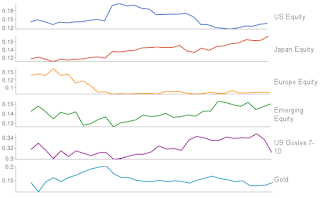
Risk Parity Attractiveness March Trends Japan and Emerging Equity markets have  strong liquidity trends US Equity and Gold have  moderate liquidity trends Europe Equity markets are liquidity neutral US Govies 7-10 have a negative  liquidity trend    Methodology The Macro Liquidity Trends are computed using a Risk Parity Approach which has become more and more popular among Asset Managers and Pension Funds:  the risk weighting for each index/asset-class is calculated using the inverse of its historical volatility.  Volatilities are estimated based on three months of weekly return data. Risk Parity in the press "The employee pension fund of United Technologies has gradually increased its risk parity-related investments to $1.8bn, or about 8% of its total assets, up from an initial 5% allocation in 2005. At the San Joaquin County Employees' Retirement Association, in Stockton, California, risk parity now amounts to 10% of the ...

Systemic banks tracker: Deutsche Bank

Image
Edvard Munch's  “ Separation ” (1896) Deutsche Bank settles dispute with regulators (Canada) By Barbara Shecter, Financial Post February 9, 2013 Deutsche Bank Securities Ltd. has agreed to pay a $1-million fine to settle with regulators over its involvement in the 2007 freeze in Canada's market for asset-backed commercial paper. In a settlement Deutsche Bank reached with Canada's investment industry regulator on Friday, the bank admitted that in late July and early August 2007 it failed to "engage" its compliance department with emerging issues in the ABCP market. Read more   Bank Regulation May Hit Deutsche Bank Harder Than Expected By Madeleine Nissen, WSJ Blog Germany’s plans for tighter financial market regulations is likely to hit Deutsche Bank harder than once expected. That’s because the legislation, which will require big banks to separate retail and investment activities, will be especially stringent when it co...

Quantitative Easing and currency war

Image
          Famous Samurai in Battle - Hideyo A Zero-Sum Game “Currency war” is ministerial parlance for lowering the value of your nation’s currency so your exports are cheaper and your imports more expensive. That helps domestic growth. It can also drive up inflation—which in the case of deflationary Japan is not such a bad thing. Critics call it a beggar-thy-neighbor policy because trade is a zero-sum game : If one country racks up bigger surpluses, another must run bigger deficits. Competitive devaluation is even blamed by some economists for contributing to the Great Depression. Quantitative Easing in Japan The recently-elected Japanese government of Prime Minister Shinzo Abe is trying to end years of chronic deflation and recession by putting the Bank of Japan under pressure to weaken the yen as a way to boost exports. Japan's new government is pressing the Bank of Japan to set a 2% inflation target, doubl...